This is default featured post 1 title

Go to Blogger edit html and find these sentences.Now replace these sentences with your own descriptions.This theme is Bloggerized by Catalin - Premiumbloggertemplates.com.

This is default featured post 2 title

Go to Blogger edit html and find these sentences.Now replace these sentences with your own descriptions.This theme is Bloggerized by Catalin - Premiumbloggertemplates.com.

This is default featured post 3 title

Go to Blogger edit html and find these sentences.Now replace these sentences with your own descriptions.This theme is Bloggerized by Catalin - Premiumbloggertemplates.com.

This is default featured post 4 title

Go to Blogger edit html and find these sentences.Now replace these sentences with your own descriptions.This theme is Bloggerized by Catalin - Premiumbloggertemplates.com.

This is default featured post 5 title

Go to Blogger edit html and find these sentences.Now replace these sentences with your own descriptions.This theme is Bloggerized by Catalin - Premiumbloggertemplates.com.

vineri, 18 mai 2012

10 Largest Container Shipping Companies in the World


All the same there are a few international shipping companies that lead the race in terms of the scale of operation of their shipping lines. Ten of these leading shipping conglomerates can be listed down as follows:
1. NYKAn acronym for the Japanese shipping company Nippon Yusen Kabushiki Kaisha, the NYK is one of the biggest cargo companies operating internationally.
The company has been in operation since the 1870s, operating a passenger fleet-line before undergoing a transition into a core container shipping company towards the mid-20th century.
2. Evergreen Marine CorporationA shipping conglomerate based in China, the Evergreen Marine Corporation was founded in 1968 by Dr. Yung-Fa Chang, a visionary in his own right.
At present, the company has offices established all over the world and with a operational capacity of more than 160 container ships is regarded to be one the largest cargo shipping companies in the world.
3. CMA-CGM:  France’s leading container shipping company, CMA-CGM came into existence in the year 1978, as a result of series of mergers between previously established shipping corporations. Jacques Saade who is the head of the company was the instrumental force behind its coming into active operation.
At present, the company has a fleet of over 350 ships operating in over 150 routes globally.
4. MaerskA shipping corporation based in Denmark, Maersk Shipping Line is a branch of the AP Moller- Maersk company. Widely well-known for its fleet of container ships, the Maersk Line made its debut in the international container shipping arena in the year 1904.
At present, the company has a fleet of around 500 container ships with a capacity of around 19, 00,000 TEU (Twenty-Foot Equivalent Units).
5. MSCThe Mediterranean Shipping Company, abbreviated to MSC is a Swiss international cargo company which was established in the year 1970.
At present, with a vessel line-up of over 456 container ships, the conglomerate is rated to be one of the most extensive cargo companies in the world.
6. Hapag-LloydThe German based Hapag-Lloyd is one of the most renowned and well-featured companies in terms of international shipping companies. The company was established in the year 1970 as a result of a merger between the Hamburg-American Line and the North German company Lloyd.
Today the shipping corporation has over 130 ships catering to about five million containers on a worldwide scale.
7. APLAn auxiliary company to the Singaporean Orient Shipping Lines, APL is an abbreviation for American President Lines. Founded in the year 1848, the shipping conglomerate just celebrated its 160th anniversary in the year 2008.
One of the most noteworthy achievements of the company is that it was the first company to successfully utilise extra-large (53 feet) containers on its vessels, accounting for shorter cargo transportation.
8. COSCOThe China Ocean Shipping Company or COSCO, as it is popularly known is one of the leading conglomerates in terms of container shipping companies.
At present the company’s operations are spread over 40 countries with a fleet of 150 container ships.
9. HanjinA South Korean conglomerate, Hanjin Shipping Company is one of the largest Asian cargo companies in the world. At present the company has a cargo operational capacity of over 1 billion tonnes on a yearly basis with around a fleet of about 60 ships.
In the year 2003, Hanjin and COSCO formed a strategic alliance. The alliance has benefited both shipping conglomerates and powered them to an unequivocal position as Asia’s leading cargo shipping companies.
10. CSCLCSCL is the abbreviation for the China Shipping Container Lines, a company based in Shanghai. Started in the year 1997, the company soon rose amongst its ranks and today has propelled not just itself but also the country to leading heights in the container shipping industry. The company finds its name in both the Hong Kong and Shanghai Stock Exchanges.
Container shipping is a huge industry and these key players are aware of the minutest operational manoeuvrings necessary to power them to being the world leaders in the commercial enterprise, not just in their home countries but also at an international level.
Top 7 Important Websites For Marine Engineers


These websites must be book-marked by all marine engineers!
Putting our own website right at the top of the list might seem like a marketing tactic, but then we do provide a wide range of articles and latest updates on marine engineering and maritime technology in the simplest language possible. Can you deny that?
Marine Insight offers almost everything, from details on construction and operation of ship’s machinery to onboard safety and latest news. The best part is that Marine Insight is made by maritime professionals, for the maritime professionals.
This website has got everything that a marine engineer needs for preparing for the competency exams. Right from the basics to in-depth case studies, this is definitely a one-stop destination for a resourceful marine engineering knowledge.
One of the main reasons Dieselduck is a must-visit website for marine engineers is that it has got loads of information of a variety of subjects related to maritime industry. Don’t miss the great compilation of videos featured in the “Videos” section of the website.
If everything about marine engines gives you an adrenaline rush, then you would adore this website. Herein, marine engines have been dissected, explained, and offered to the readers in the best possible manner. Don’t forget to check out the “horror stories” section of the website – a must read for all maritime professionals.
Just as the previous website is all about marine diesel engines, steam esteem is all about marine boilers. From information on steamships to various problems related to marine boilers, this website seems to have everything on it. If marine boilers is your area of interest or is a subject that is giving you trouble then this is the one-stop destination for you.
Though the bright hub marine engineering channel offers the best of both deck and engine department, there are some great articles on various marine engineering subjects in here. The only drawback is that it is not updated frequently.
Diesel ship is a great website which has some amazing resources on marine engineering. The salient feature of this website is the highly informative technical videos offered by the “dieselshipacademy”. The website also offers examination preparation material along with other useful information.

Naval Architecture links

miercuri, 16 mai 2012

High Performance Turbine Installation Vessel

The High Performance Turbine Installation Vessel is a new vessel concept from Wärtsilä and Aker Solutions.

Wärtsilä Hamworthy wins third FSRU


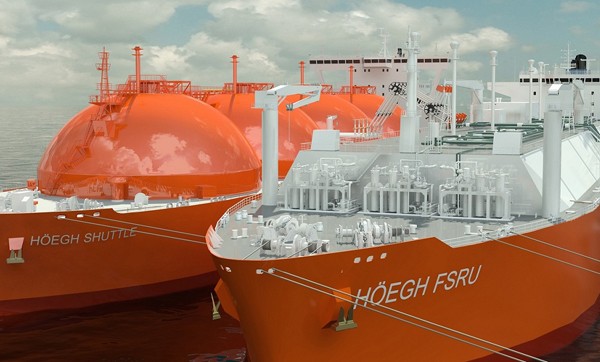
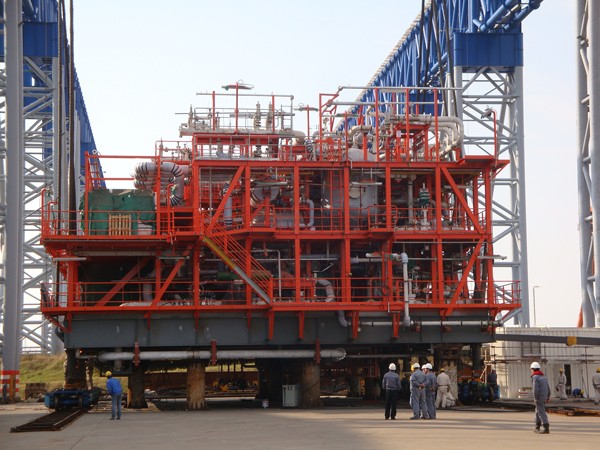
Hamworthy Oil & Gas Systems has secured a contract to supply its innovative LNG regasification technology for the third Höegh LNG Floating Storage and Regasification Unit (FSRU) under construction at Hyundai Heavy Industries.
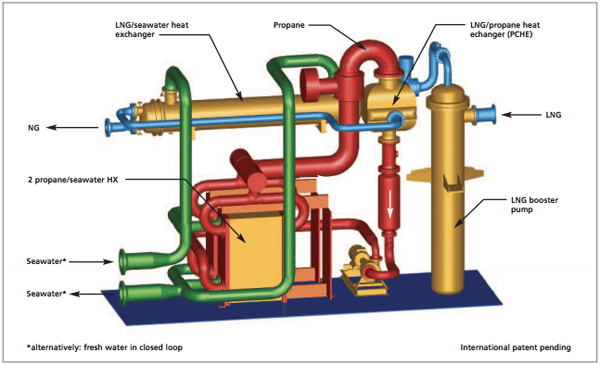
Here’s how it works:
In this system, LNG is heated by propane in a closed loop and the propane is heated by seawater. In situations where the seawater is too cold to supply all the required heating energy, additional heat can be introduced.
The cascade concept is recommended instead of directly heat exchanging with seawater. LNG heat exchanged directly with seawater increases the risk of freezing the seawater in the heat exchanger. Propane as a secondary medium is suggested because of its thermodynamic properties with a low freezing point.
A HAZID analysis has been carried out with DNV to identify risks related to the design and operation of the regasification system. For example, it was concluded that the cascade system is a safer system than the pure seawater based.  LNG enters a cryogenic pump capable of producing the required send-out pressure (e.g. up to 130 bar has been studied). LNG at the required discharge pressure is heated in two stages.
In the first stage LNG is heated from -160°C to -10°C in a compact printed circuit heat exchanger with propane as a heating medium.
In the second stage, LNG can be heated further using seawater as a heating medium in a shell and tube heat
exchanger.
In the LNG/Propane heat exchanger, heat is exchanged against propane circulating in a closed loop. The propane enters the heat exchanger at approx. 0°C at 4.7 bar as gas. In the heat exchanging process propane is condensed, and leaves the exchanger in a liquid state at approximately -5°C.  The propane in the closed loop is then pumped by the circulating pump and heated against seawater in titanium semi welded plate heat exchangers. In these heat exchangers, the propane is evaporated and heated to 0°C before returning as gas to the printed circuit heat exchanger.
Working together with Sinopacific Offshore and Engineering (SOE), Wärtsilä Hamworthy will design and supply the system concept whilst the key equipment and fabrication will be supplied by SOE.
This partnership agreement follows on from the contract to supply a propane-seawater regasification system for the first two 170,000m3 capacity vessels signed in November last year.
FSRU Hoegh lng
Rendering courtesy Hoegh LNG


Marine Solutions

Wärtsilä is passionate about optimising lifecycle value by offering whatever its customers in the marine industry need from the only complete portfolio of marine products, integrated solutions and services in the industry. The shorter route to bigger profits for the customers is offered by focusing on operational efficiency, environmental excellence, fuel flexibility and services.
Container vessel specifications


HTC One X and Evo 4G LTE delayed patents


HTC One X and Evo 4G LTE shipments delayed at US Customs due to Apple patents

So this is pretty big news: The Verge is reporting that it has learned that shipments of HTC’s One X and Evo 4G LTE handsets have been indefinitely delayed at US Customs due to an import ban order handed down by the ITC last year.
The International Trade Commission ruled last December that HTC was infringing upon an Apple patent regarding the auto-hyperlinking of phone numbers and other data in text, resulting in a country-wide ban of HTC’s products…
The injunction went into effect on April 18th, and these two handsets — two new flagship devices for HTC — are the first products to face an import delay due to the ITC’s ruling.
Here’s HTC’s official statement on the matter:
“The US availability of the HTC One X and HTC EVO 4G LTE has been delayed due to a standard U.S. Customs review of shipments that is required after an ITC exclusion order. We believe we are in compliance with the ruling and HTC is working closely with Customs to secure approval. The HTC One X and HTC Evo 4G LTE have been received enthusiastically by customers and we appreciate their patience as we work to get these products into their hands as soon as possible.”

HTC can try to stay the ban, but chances are it’ll just let Customs do its thing. The last we heard, the Taiwanese manufacturer had successfully created a workaround to Apple’s patent. So it shouldn’t be long before Customs verifies that and releases the shipments.
Of course, any kind of delay is a big deal to HTC right now, who has been struggling to find a hit product over the past 12 months. And while the One X has drawn a lot of attention from both the media and consumers, it’s currently sold out in most major US retail stores.


why the Facebook iOS app is so bad


Facebook’s iOS app is terrible.
That’s not a matter of opinion: it’s fact. It’s a festering pile of an app, with an average 2 star rating on the US iTunes App Srore.
The app’s slow. The notifications don’t work. The whole thing’s buggy. In every way imaginable, if you open Mobile Safari and type in facebook.com, you’ll have a better experience.
How could a company like Facebook that sees so much of its traffic come from mobile sources release such a terrible, unuseable app? And why hasn’t it gotten better?
As it turns out, some of it’s due to the inherent nature of Facebook, which is “move fast and break things.” Some of it’s due to bugs. And some of it’s because the only alternative is to wait for Apple to approve every change Facebook makes to its system.
Over at the Mobtest blog, they took the Facebook iOS app and did some packet sniffing to figure out just why the app had so many rudimentary problems displaying things like notifications and timelines when the Mobile Safari version runs just fine.
The post itself is a little technojargony, but what it comes down to is that the Facebook iOS app is an Objective C wrapper around Facebook’s raw HTML data, using iOS’s UIWebView component, which allows devs to display a web page in an app.
UIWebview is also slow. Very slow. It doesn’t have access to Mobile Safari’s blistering Nitro javascript engine, making it slower than loading up Facebook in the native browser. Worse, it’s absolutely junk at figuring out what it needs to download versus what it’s already got on hand, leading the app to redownload your entire timeline each and every time it loads itself, instead of just the chunks it needs.
Why would Facebook have its app work this way? Partly it’s because the web site is in HTML, and HTML can be displayed across Blackberries, Windows Phones, Android devices, etc.
Why doesn’t Facebook just use Objective C? A big part of it is that Objective C is actually rubbish at doing fluid layout thinks like having an image with text around it, or buttons with different kinds of text labels. What it mostly comes down to, though, is Facebook is a constantly evolving product across multiple platforms, including the desktop, and HTML is much more in-line with Facebook’s deployment process, as Mobtest explains:
FB developers are responsible for their own QA, and part of that is to push code out to a limited set of servers, see results and then push it out to more and do this each day if not more often. With Apple taking as least a week of review, rolling back a code change is a nightmare.
So there you go. These are all the technical reasons why you should probably delete that rubbish Facebook app and just use a bookmark in Safari instead.

luni, 14 mai 2012

The Jet engine

The book is aimed at engineers and engineering students - and, indeed, anyone interested in the detail of one of the most complex machines of our time; it covers everything from an introduction to the theory of jet propulsion to in-depth component definitions, from basic mechanics to maintenance and overhaul.


[Gas Turbine, Turbojet, Turbofan] Rolls Royce - The Jet Engine

Pipe Stress Analysis

BoxCooler Suppliers

Improved Box Cooler


Weka International and Carpen Consultants (The Netherlands) announced a joint development project - Conihex (Copper-Nickel Heat Exchanger), which will result in more price competitive, smaller, and more efficient box coolers. The box cooler is considered to be very efficient way of cooling ship's diesel engines. Unlike conventional cooling systems taking in raw water into the ship where the engines are cooled via heat exchangers that require expensive piping and valves, box coolers offer space saving and provide environmentally friendly solutions.
The project is expected to improve heat efficiency and material usage, as well as to improve calculation methods for box coolers. The modular concept is thought to reduce delivery time to 3-4 weeks. The project’s focus will be on boxcooler's heat conductivity, mechanical strength and resistance, anti-fouling properties, protection against corrosion, and modularised design.

Share

Twitter Delicious Facebook Digg Stumbleupon Favorites More